
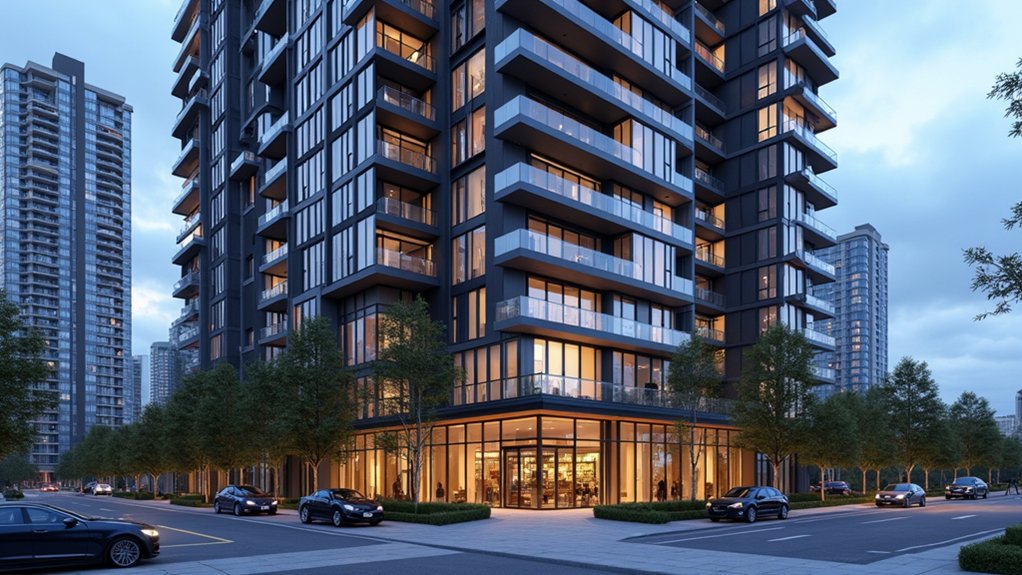

Toronto’s condo market just staged a quiet rebellion against the doomsayers. I’m watching July’s numbers roll in, and here’s what catches my eye: sales barely budged year-over-year at about 1,564 units across the GTA, yet prices kept sliding. That disconnect tells me something’s shifting beneath the surface.
Toronto’s condo market just staged a quiet rebellion against the doomsayers, with sales holding steady amid sliding prices—a disconnect signaling deeper shifts beneath the surface.
I’ve spent fifteen years watching Singapore’s property cycles, and I’ve learned to distrust narratives that claim markets simply “collapse” or “recover.” Toronto’s condo scene right now? It’s neither. The average GTA condo fetched $636,323 in July, down 2.3% from last year, but that moderation from steeper drops earlier in 2026 matters. Some series even ticked up 0.9% month-over-month. The doomsayers predicted a bloodbath; instead, buyers absorbed inventory without triggering panic selling.
Here’s where I lean in closer. The MLS HPI benchmark plunged 7.35% year-over-year to roughly $535,200, while average prices fell far less. That gap reveals something contrarian: the mix of what’s selling has degraded. We’re seeing more distressed or lower-quality units trade, dragging the benchmark down, while decent product holds firmer than headline numbers suggest. In Singapore, I watched similar divergence during 2013’s cooling measures—benchmarks cratered, but prime District 9 stock proved surprisingly sticky.
So what does this mean if you’re actually buying or investing? You’ve got leverage, plain and simple. With roughly 10.2 months of inventory and new listings outpacing sales nearly three-to-one, you’re negotiating from strength. That 97.6% sale-to-list ratio in the city? Sellers still hold some pride, but 28-40 days on market means they’re feeling the pressure. I’d tell my cousin in Scarborough: target Toronto Central where 726 sales concentrated, but don’t ignore East End value at $512,062 average if you’re willing to ride the gentrification wave longer.
The geographic split fascinates me too. Peel at $494,725 versus Halton at $625,223—I’ve seen this movie in Singapore’s OCR versus RCR divergence. The 905’s catching a chill faster than the 416, which reminds me of how Punggol languished while Tiong Bahru soared post-2008. Active condo listings reached 8,352 at month-end, representing months of inventory at the current sales pace and keeping buyers firmly in control of negotiations.
Builders keep completing units, investors keep listing, and that supply wave isn’t cresting yet. Analysts watching Singapore’s February 2025 market noted that pent-up suburban demand can ignite sales volumes almost overnight when new supply has been constrained for years, a dynamic Toronto’s 905 corridor could yet replicate if rate conditions shift favorably. But I’m watching autumn closely. If sales hold steady through September without fresh inventory shocks, we’ll mark July 2026 as the month Toronto condos found their floor—not with a bang, but with a shrug. And for anyone still on the fence, remember that TRREB MLS via PropTx powers the live data behind these trends, so the lag between reality and perception is shorter than ever.