
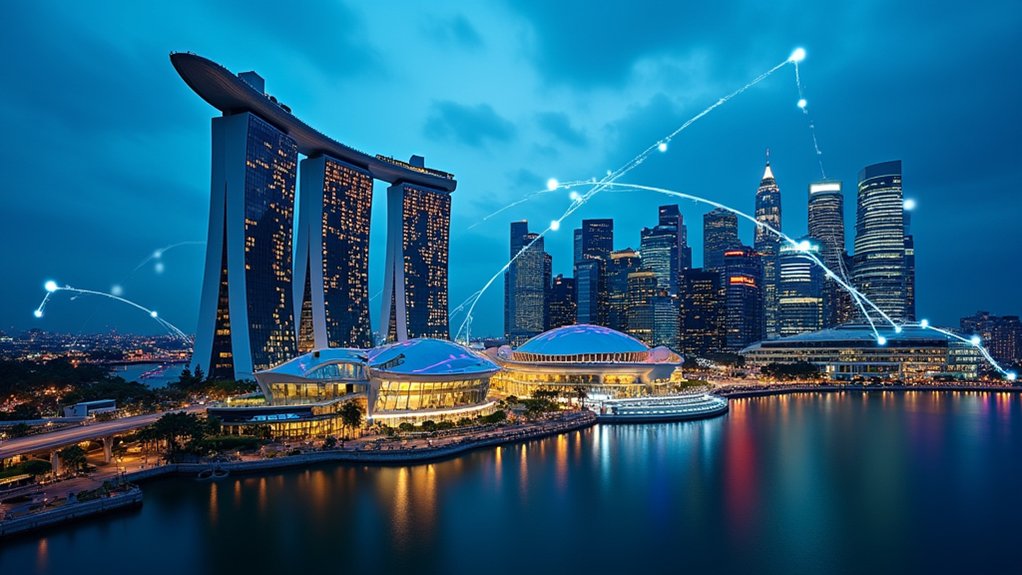

As built-environment risk factors increasingly converge, the WiredScore Global Cities Resilience Index 2026 positions Singapore at #2 globally, trailing only Chicago and ranking ahead of other leading markets such as Dubai and Madrid, based on an assessment of commercial real estate (CRE) resilience across cyber threat exposure, climate impact, power instability, and technological advancement.
In this framework, resilience is treated as an operational attribute that can materially influence tenant confidence, asset liquidity, and the competitive positioning of districts within the built world. The report also highlights Disconnected indoor connectivity as a silent risk as legacy mobile networks are phased out, creating new indoor coverage gaps.
WiredScore’s 2026 analysis characterises resilience as moving from theory to reality, as buildings are increasingly tested simultaneously by climate disruption, digital dependence, and escalating cyber risk. It also identifies a global “Resilience Gap”, noting that only 5% of occupiers have deployed AI at scale, largely because building-level constraints limit the required digital, physical, and cyber foundations, and thereby suppress the practical adoption of advanced workplace technologies. With global cybercrime projected to cost $23 trillion by 2027, the index underscores why resilience is increasingly treated as a measurable economic safeguard.
Resilience has shifted from theory to reality, as climate shocks, digital dependence, and cyber risk expose a global AI adoption gap.
Singapore’s performance is reinforced by parallel cyber resilience benchmarks in which it ranks #1 globally, achieving a final score of 99/100 across 38 countries. The country records perfect 20/20 results for technical capability, cybersecurity institutions and strategies, cooperation measures, and the cybersecurity-related law index, while long-term skills building scores 19.86/20.
Capacity indicators remain notable, with 1,329 cybersecurity professionals per 100,000 people and the world’s highest digital development level at 86.93; sectoral assessments further show Agriculture, Energy, and Healthcare each receiving 100% A ratings, with the Financial sector also demonstrating strong posture.
Macro and leasing conditions in 2026 provide additional context, with GDP growth projected at 1–3%, slower than 2025’s 4.8% year-on-year expansion. Even so, the office market is expected to remain resilient, with Core CBD Grade A rents projected to grow faster amid firm demand and limited supply, while industrial and logistics rents resume mild growth under sustained demand and constrained availability.
Retail prime rents are anticipated to increase, supported by sales growth, tourism recovery, and below-average new supply, and investment activity is forecast to remain top three in APAC, with transaction volumes rising on a healthy asset pipeline despite persistent geopolitical risk. Real estate investment volumes increased by 28% YoY to S$28.62 billion in 2024, reflecting Singapore’s standing as a safe haven for investors seeking stability amid global uncertainty.