
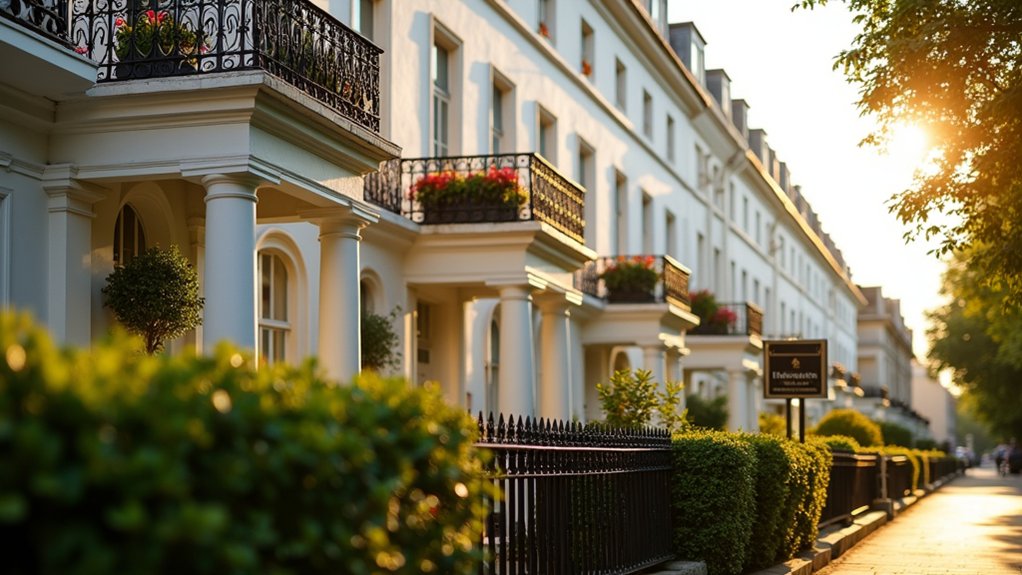

Although prime London residential values remain materially below their 2014 peak, resilient buyer demand in specific high-value enclaves of central and southwest London is beginning to underpin a measured recovery in the capital’s prime markets.
Forecasters project a modest price uplift in 2026 as interest rate pressures ease and postponed transactions re-enter the pipeline.
London prices, still around 22.4% below their previous high and having underperformed most UK regions, are nevertheless showing early signs of stabilisation in the most established prime postcodes.
Family buyers continue to transact despite political and fiscal uncertainty. This resilience is expected to be reinforced as falling interest rates combine with improved supply to support a more broadly based recovery across London’s prime postcodes. In parallel, buyers are placing greater emphasis on energy-efficient homes, with strong demand for properties boasting higher EPC ratings and modern insulation as running costs and sustainability concerns rise.
Price forecasts for 2026 indicate a modest but broad-based upturn.
Both Savills and Knight Frank project Greater London growth of around 2%, with prime outer London expected to rise by a similar margin, while prime central London is generally forecast to be broadly flat on a headline basis.
Capital Economics presents a more optimistic scenario, anticipating around 5% price growth, contingent on the Bank Rate declining from 4.25% to 3.00%.
Knight Frank’s medium-confidence central case of approximately 3% reflects ongoing affordability constraints.
The interest rate trajectory is a critical determinant of this recovery, with borrowing costs expected to fall to their lowest level in three years.
This will improve mortgage affordability and gradually restore buyer confidence.
Market commentators suggest that lower rates will ignite more meaningful buyer activity from spring 2026.
The mere prospect of rate cuts is already beginning to support demand and pricing expectations.
Current market activity indicators remain subdued.
This follows a period in which government policy changes, including the scrapping of non-dom rules, a 2% stamp duty increase, and mansion tax discussions, depressed sentiment and contributed to three consecutive quarters of price falls in prime central London.
New buyer enquiries registered a net balance of -32% in November 2025, with London at -44%, the weakest regional reading in the UK.
High-value purchasers paused decisions, particularly for assets above £500, where demand fell by 9%.
Despite this, agents report a growing backlog of postponed moves.
There is a bottom‑up recovery led by first-time and everyday buyers across the wider UK, with stronger growth expected in the Midlands and North due to superior affordability.
In prime central London, however, the market is shifting from distressed to more balanced conditions.
This is supported by increased housing supply and expectations of a post-holiday and post‑Budget surge in activity as rate cuts materialise and deferred capital re-engages.
Internationally, investors facing geopolitical tensions and inflation pressures in other global markets are increasingly viewing resilient property sectors with transparent regulatory frameworks as strategic safe havens.
This outlook is consistent with consensus projections of a modest 2–5% recovery over the next cycle.