
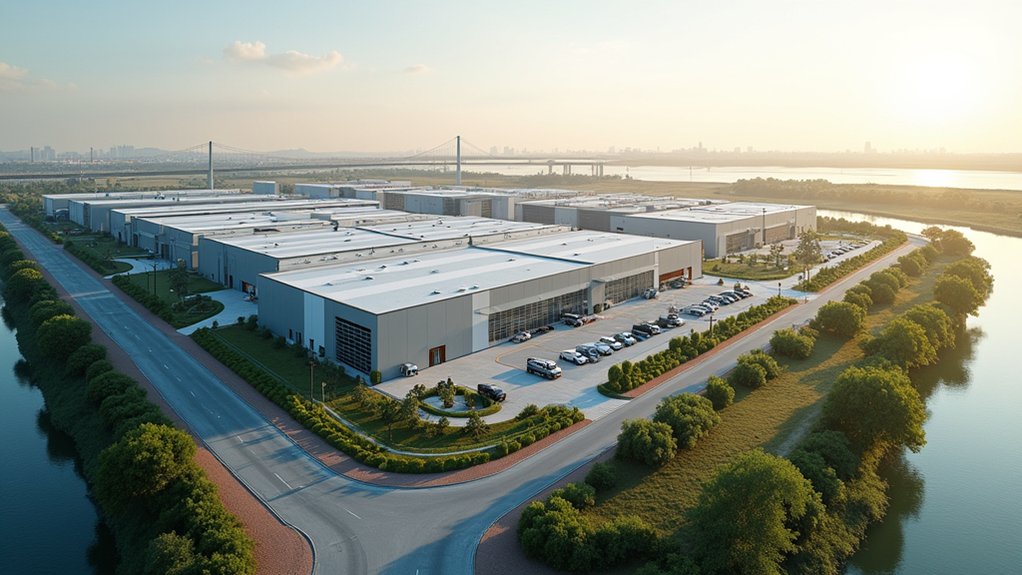

Against the backdrop of Singapore’s Budget 2026 economic positioning, JTC has been tasked with master-planning and developing the Woodlands Gateway district as a northern gateway aligned to the Johor-Singapore Special Economic Zone (JS-SEZ), a mixed-use precinct of up to 35 hectares—about 50 football fields—intended to function as a manufacturing and corporate-services node linking Woodlands to cross-border production capacity and regional market access. The initiative was announced in Parliament during the Budget 2026 debate on March 2, 2026, and is framed to support firms that pair manufacturing capacity in Johor with regional headquarters, sales, innovation, and R&D functions in Singapore, reinforcing “twinned operations” across the Straits.
JTC will develop Woodlands Gateway—up to 35 hectares—as a JS-SEZ-linked northern node enabling “twinned operations” across Singapore and Johor.
The district is planned around the upcoming Johor Bahru–Singapore Rapid Transit System (RTS) Link station and Woodlands North MRT station, with a transport hub integrated to both rail interfaces, thereby shortening transfer times for cross-border commuters while serving residents of the Woodlands North Coast estates and employees in nearby industrial areas.
With the RTS Link strengthening access to Johor, the site is positioned as a high-connectivity landing point where corporate services, light industrial activity, and supporting retail can co-locate adjacent to rapid transit.
JTC’s master plan provides for flexible industrial and office space, general manufacturing and industrial developments, and a layer of commercial and lifestyle amenities to cater to workers, residents, and transit passengers, while retaining a vegetated hill indicated in the development concept. This phased, mixed-use approach mirrors strategies seen in other major Singapore precinct developments, such as the Jurong Lake District, which has similarly been broken into smaller, more manageable plots to reduce risk and accelerate the creation of a business district outside the city centre.
The first phase is expected to be completed around 2030, with subsequent phases to be rolled out progressively in response to business demand, tenant requirements, and the evolving operational profile of the JS-SEZ.
The economic rationale is tied to a broader internationalisation push from the second half of 2026, supported by enhanced grant structures, including the Market Readiness Assistance grant raised to 70% for SMEs from April 2026 and extended to all firms at 50% from H2 2026. From H2 2026, MRA will also support expansion in existing markets.
A new Enterprise Development Grant (EDGE) is intended to streamline support up to S$100,000 annually, with further details slated for later in 2026.
Industry configurations cited include Edmund Optics, which operates sales and R&D from Woodlands while maintaining manufacturing in Johor, a model aligned to ASEAN’s projection as the world’s fourth-largest economic bloc by 2030, and complementary regional nodes such as Batam, Bintan, and Karimun.
Parallel JS-SEZ efforts under study include marketing proposals and an SME supplier directory, alongside LaunchPad@Punggol Digital District phases from end-2026 and an Open Digital Platform enabling data simulations for smart-city pilots, as well as logistics MOUs, data-centre developments, and aviation clearance pilots. In parallel, JTC is also streamlining industrial lease assignments for eligible small sites to reduce processing time to within about one month.