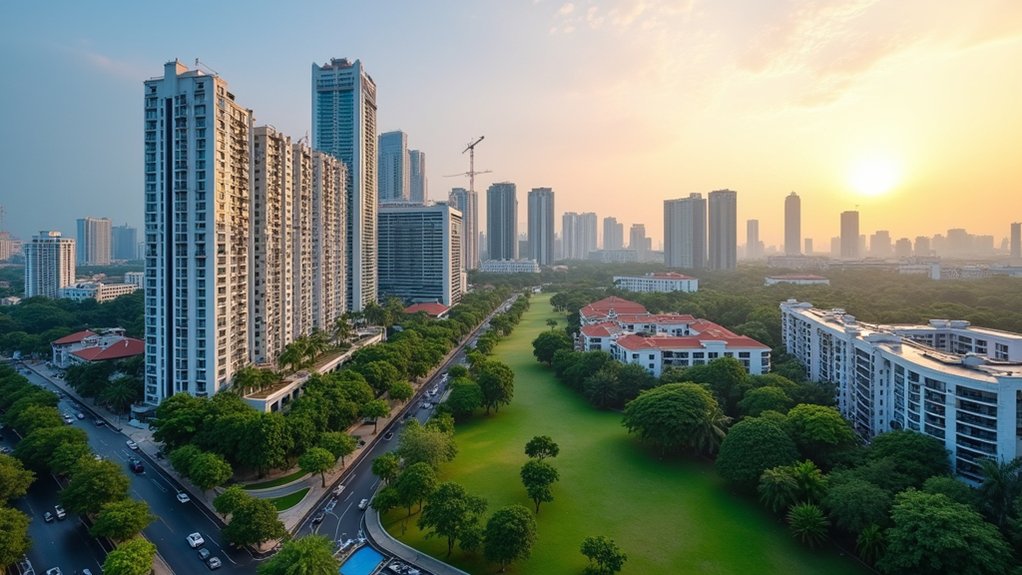

Few redevelopment plays in Singapore’s recent history carry the sheer spatial ambiguity — and consequently the speculative tension — that Turf City does: 161 to 176 hectares straddling the District 10 and District 21 boundary, with no GLS tender gazetted as of mid-2026 and a build-out horizon stretching potentially to the 2040s.
Few redevelopment plays carry the speculative tension that Turf City does — and that ambiguity is precisely the point.
That uncertainty isn’t a weakness. For buyers and investors who understand how Singapore’s planning machine works, ambiguity at this scale is often where the real money gets made.
The programme itself is genuinely mixed. You’re looking at a projected 3,000 to 8,000 private residential units across multiple phases, sitting alongside HDB estates, a nature park of up to 40 hectares, 22 conserved heritage buildings, and a Cross Island Line station targeted around 2032.
That’s not a single development — that’s a new urban quarter, one with its own neighbourhoods carrying names like Racecourse Neighbourhood and Saddle Club Knolls, each designed to carry a distinct identity that residents can genuinely root themselves in.
Here’s the contrarian read: the green-buffer commitment — 40 to 50 percent of the site reserved for parks and corridors — will constrain buildable GFA more than most analysts currently price in. That means effective density stays lower, unit sizes trend larger, and the eventual private product skews premium.
This isn’t One-North. It’s closer in character to the Bukit Timah corridor itself, and pricing will reflect that.
Industry estimates suggest first-phase GLS confirmation alone could add three to eight percent PSF to the closest D10 and D11 sub-districts. For context, projects along Coronation Road and Farrer Road — already trading at elevated freehold premiums — could see that cushion thicken meaningfully.
If you bought into something like Leedon Residence or The Sixth Avenue Residences in the last cycle, you’re sitting in the right postcode.
The site’s long history as home to the Singapore Turf Club dates to the 1930s, and the master plan’s commitment to integrating 22 heritage buildings into public spaces grounds the precinct’s identity in something genuinely irreplaceable rather than manufactured. Singapore’s broader planning agenda has similarly embraced transit-oriented planning as a mechanism for weaving new residential precincts into existing workplace, leisure, and green space networks, a principle that will shape how Turf City’s phased neighbourhoods ultimately connect to the wider district.
What I’d watch is the 2032 CRL station milestone. Transit confirmation historically triggers the sharpest re-rating in nearby values, often front-running actual completion by three to four years. The site’s Rail Corridor connectivity further reinforces this long-term value proposition, linking the precinct directly to Bukit Timah Nature Reserve and the broader southern green corridors activated progressively by NParks since 2021. That window, I’d argue, is where the real positioning happens.