
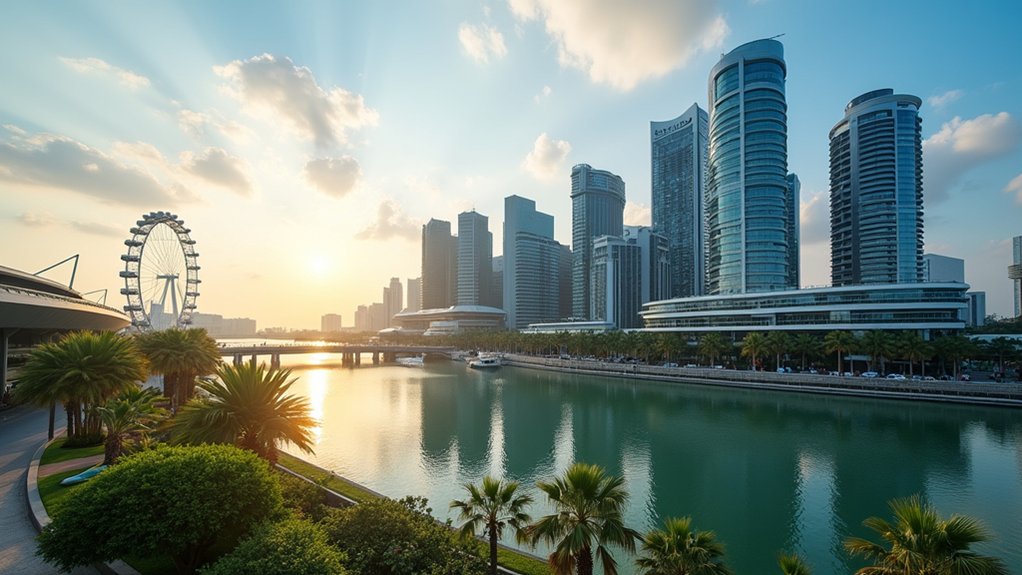

Amid a moderating inflation backdrop and sustained, trade-linked economic momentum, Singapore’s property market in 2026 is positioned to exhibit continued resilience, underpinned by macro stability and structurally tight supply conditions across multiple asset classes. GDP growth is projected at 2–4% in 2026, easing from 2025’s 4.8% y-o-y expansion into a 1–3% range, while inflation is expected to settle at 1–2%. Trade-related sectors are expected to sustain activity, and a favorable business outlook is reflected in a +10% net weighted balance for the services sector.
Singapore’s 2026 property market looks resilient as inflation moderates, trade momentum holds, and GDP growth steadies at 2–4%.
Against this backdrop, ERA and Huttons characterise Singapore as a flight-to-quality market, citing capital inflows during global uncertainties and the city-state’s ranking as the second most resilient real estate market globally, and a top three investment destination in APAC. In the Core Central Region, non-landed private home prices rose 2.2% in 2025, as price appreciation softened to a more sustainable pace. For 2026, private home prices are forecast to expand by 1–5%, supported by lower interest rates that reduce borrowing costs, policy continuity, and household support measures.
Supply remains a critical stabiliser, with limited new stock across residential, commercial, and industrial segments, construction delays and land scarcity underpinning pricing power. This reinforces Singapore’s position as a safe-haven market amid global uncertainties. About 17 new private residential launches are anticipated in 2026, even as vacancy rates in private residential exceed 30% and certain subsegments face potential oversupply. The public resale market is expected to remain firm, with HDB resale prices projected to rise 2–4% in 2026, broadly consistent with stable, low-rate conditions. Real estate investment volumes in Singapore surged 28% year-on-year to S$28.62 billion in 2024, underscoring the sustained confidence of foreign and institutional investors in the market’s long-term growth trajectory.
Across assets, tight supply in CBD Grade A office space is expected to keep rent growth outpacing other sectors, given demand and constrained completions. Prime logistics rents are expected to resume growth as e-commerce and logistics expansion sustains absorption, while industrial rents and prices continue to rise steadily alongside stable vacancy. Policy support via Budget 2026 also reinforces structural demand for modern industrial and business park space aligned with high-value industry clusters. Retail, supported by tourism spending growth and improved leasing sentiment, is expected to register rental increases against below-historical-average incoming supply.
Nonetheless, ERA and Huttons flag geopolitical tensions, tariff uncertainties affecting industrial investment decisions, and regulatory measures aimed at cooling speculation as factors that may temper sentiment.