
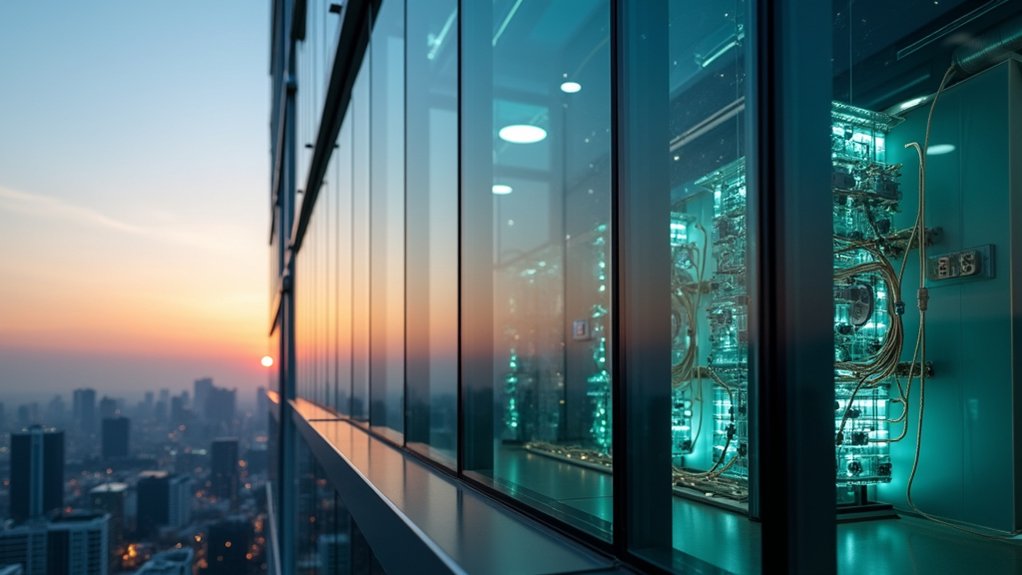

How can built assets maintain structural performance when micro-cracks, corrosion, and localized impact damage accumulate across decades of service life? Self-healing building materials address this risk profile by embedding mechanisms within structural components that enable automatic repair without human intervention, thereby shifting maintenance from scheduled replacement to condition-based regeneration. Active agents, including microcapsules of healing chemicals, bacteria, and shape-memory fibers, remain dormant until a breach is detected, then trigger “localized repair responses” that seal the compromised zone. By sealing hairline openings early, these systems help prevent corrosive ingress that can accelerate reinforcement corrosion and freeze-thaw damage.
In bio-concrete, specialized microorganisms are incorporated as spores, and they activate when cracks admit water and oxygen, producing calcite that fills voids through calcium carbonate formation. Comparable self-healing signatures have been observed in ancient Roman structures, nearly 2,000 years old, such as the Pantheon and the Colosseum, indicating that mineral precipitation can sustain long-term cohesion. Synthetic analogues rely on polymer microcapsules that rupture under stress, releasing adhesives or resins that solidify and bridge hairline fractures, a process often compared to natural skin regeneration.
Artificial intelligence extends these material systems into operational “self-healing buildings” by automating fault detection and portfolio-level optimization. Embedded sensors and IoT networks monitor early microfractures, stress concentrations, moisture ingress, and facade abrasion, while machine learning predictions tailor healing-agent concentrations, fiber reinforcement placements, and material combinations to local climates. Vascular networks integrated into concrete, metals, polymers, and composites distribute healing compounds, allowing autonomous activation to reach otherwise inaccessible cracks at scale. Smart energy management systems can further integrate with self-healing infrastructure to optimize building performance across maintenance and operational cycles.
When repeated stress patterns are detected, real-time feedback systems enable AI to adjust material recipes for subsequent construction sections, improving consistency across large developments, even as standardized testing protocols remain under development. Performance benefits are framed in asset-management terms: roof and waterproofing systems reduce water infiltration and mold exposure, lowering the frequency of roof replacements, and smart composite panels on high-rise facades can self-fix surface abrasions, minor impact damage, and micro-cracks without repainting or partial replacement. Across public and private assets, this approach can deliver extended lifespans that defer costly renovations. By preserving building envelope integrity, owners can sustain structural stability and maintain energy efficiency in heating and cooling operations, while offshore installations benefit from increased durability in marine environments, reducing spill risk and pollution exposure.