
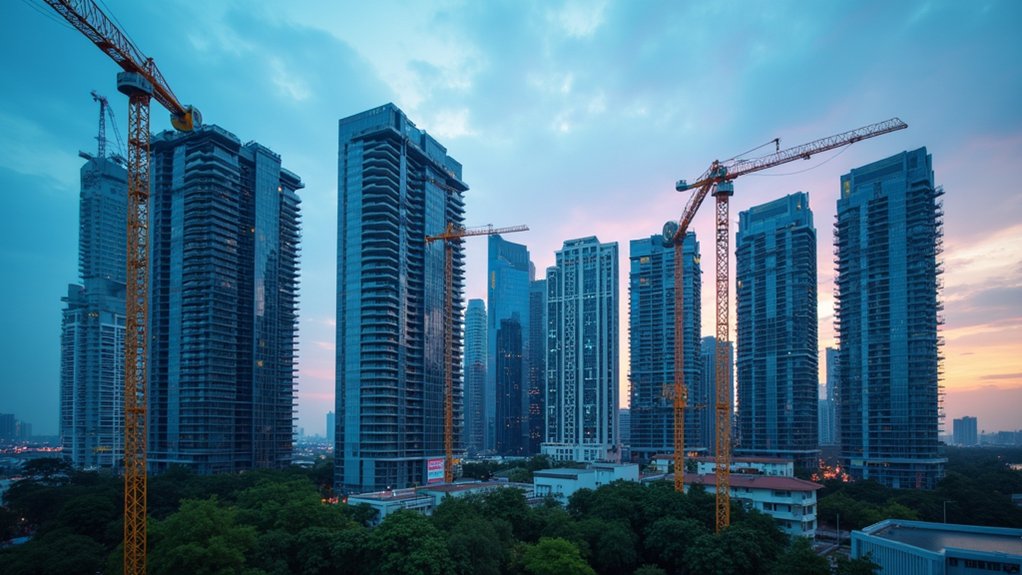

Amid a resilient demand backdrop, the Government Land Sales (GLS) programme is emerging as the primary policy lever calibrating Singapore’s private residential market. Authorities are committing to release more than 25,000 private homes between 2025 and 2027 in order to sustain what has been officially characterised as a “stable and sustainable” price trajectory.
This enlarged pipeline comprises 9,755 units on the 2025 confirmed list and an additional 15,245 units projected from GLS sites in 2026–2027. It is intended to function as a medium‑term supply buffer, moderating pronounced price acceleration while accommodating still‑firm underlying demand. With Singapore’s GDP expected to grow by 2.2% in 2026, this supply‑side strategy is reinforced by a broadly supportive macroeconomic backdrop that helps underpin household incomes and housing affordability.
Within this multi‑year framework, more than 9,000 new private homes can be built on land offered for sale in the first half of 2026 alone. This underpins a substantial launch pipeline that extends beyond the immediate horizon. The overall private housing pipeline in the GLS programme for January to June 2026 is maintained at about 9,200 units, broadly aligned with the preceding six months. The confirmed list has been trimmed for the second consecutive half‑year, even as the overall pipeline is kept elevated to preserve supply visibility.
Including executive condominiums, the stock of private homes in the pipeline is projected to rise to around 58,600 units, up from 54,100 units, when combining projects with and without planning approval.
While the first‑half 2026 confirmed list has been modestly trimmed relative to earlier periods, this adjustment is offset by a larger reserve list and an already‑elevated pipeline. This has been officially framed as a “modest adjustment” rather than aggressive tightening.
The structured, multi‑year configuration of the GLS programme is designed to reduce boom‑bust cycles in both land bids and end‑user home prices. It aims to anchor expectations among developers and buyers.
Private home prices rose 2.7% in the first nine months of 2025, extending the post‑pandemic uptrend but at a more moderate pace than the 10.6% increase recorded in 2021. This reflects the combined impact of cooling measures and improving supply visibility. Meanwhile, HDB resale prices increased by 1.5% in Q1 2025, marking the slowest quarterly growth in five quarters.
The Residential Property Price Index is forecast to increase from 210.70 in Q1 2025 to 231.00 in 2026, signalling continued, but not excessive, appreciation.
Demand remains underpinned by low unemployment, firm resale HDB prices, strong new‑launch performance, and easing interest rates. With new private home sales (excluding ECs) reaching an estimated 10,564 units between January and 23 November 2025, this marks the first time in four years that volumes have exceeded 10,000 units.
This reinforces the importance of timely GLS releases in curbing sharper price spikes, even as premium segments are expected to continue outperforming the broader market.