
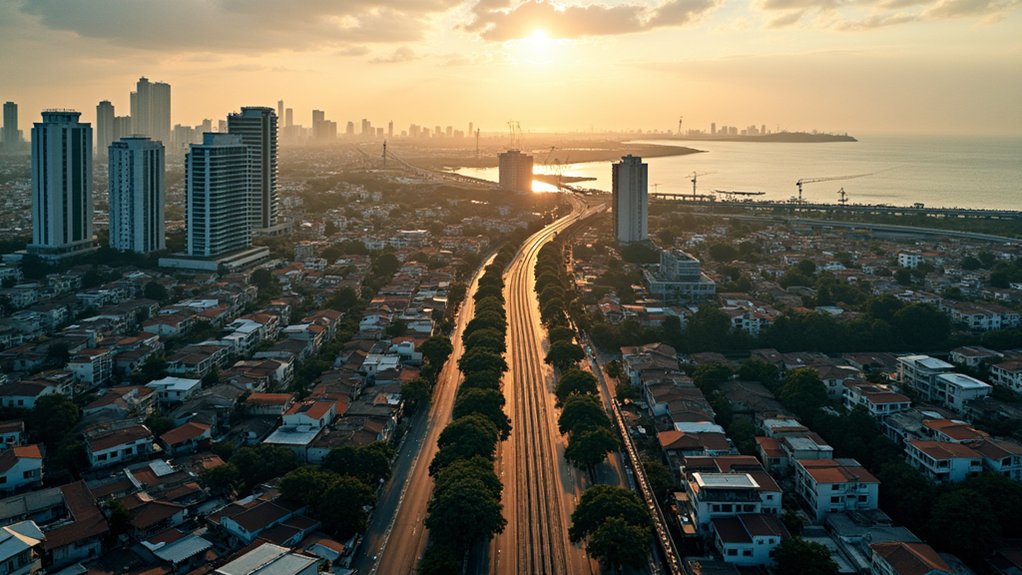

Although positioned as a transport-led catalyst for cross-border integration, the 4 km twin-track Johor–Singapore Rapid Transit System (RTS) linking Bukit Chagar in Johor Bahru to Woodlands North is set to reframe Woodlands’ accessibility profile and its surrounding commercial catchment when it commences operations in December 2026. It is also only the second rail link between the two countries.
The 4 km twin-track Johor–Singapore RTS will reshape Woodlands’ accessibility and commercial catchment when it begins operations in December 2026.
Using driverless four-car trains, it targets a 5-minute journey at speeds up to 80 km/h, with line capacity stated at 10,000 passengers per hour per direction. Eight trains are planned, each carrying 607 passengers under normal loading and up to 1,087 at maximum capacity, with daily operations from 6am to midnight and peak frequencies of 3.6 minutes, and it will replace the KTM Shuttle Tebrau service by June 2027.
On the Singapore side, the Woodlands North RTS station is integrated with the Thomson–East Coast Line via a basement connection, positioning it as a modal interchange rather than a standalone terminal. The underground station reaches a maximum depth of 28 m, arranged over three storeys with two basements, and the construction contract was awarded in November 2020 for S$932.8 million. Groundbreaking on the Singapore side took place on 22 January 2021. The Thomson-East Coast Line integration cuts travel time from Woodlands to Orchard Road from 50 to 35 minutes.
Works by Penta-Ocean Construction include tunnels and a co-located customs, immigration and quarantine (CIQ) building, enabling seamless pre-boarding clearance at both stations, and shaping a higher-throughput border-processing model. The alignment includes an elevated viaduct and a 25 m-high bridge across the Johor Strait, while the Malaysian depot is located at Wadi Hana, Johor Bahru.
In network terms, the RTS is expected to cut Causeway traffic by at least 35%, and to compress peak-hour cross-border commutes that can run 90–120 minutes into “5 minutes plus last-mile,” a change with direct implications for labour mobility and the spend radius around Woodlands. It also complements the Johor–Singapore Special Economic Zone, which is framed around streamlining customs, immigration and business operations, attracting high-value industries, and creating skilled jobs, with Johor Bahru increasingly positioned as an extended Singapore suburb.
However, improved access may destabilise parts of Woodlands’ retail base, as sales leakage to Johor Bahru is projected to rise from 4% to 5%, and to increase 30%–40% from current levels post-RTS. Frasers Centrepoint Trust has assessed the Johor retail threat while backing northern Singapore as a counterbalance, underscoring that accessibility uplift and competitive diversion can occur simultaneously.