
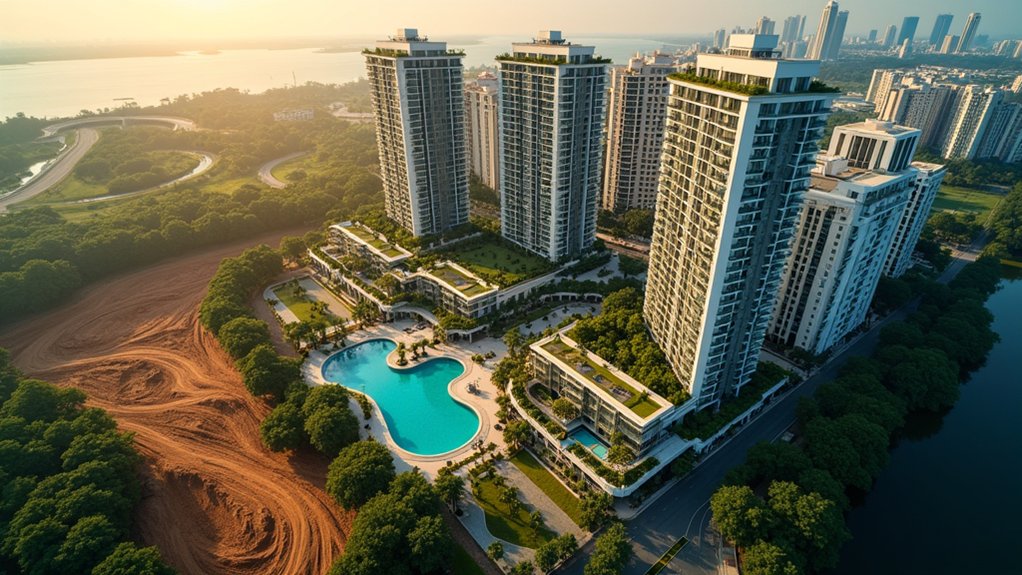

Track the pricing mechanics of a new condominium launch and the first variable that consistently anchors outcomes is the land bid, because industry rule-of-thumb frameworks such as the “70/20 Rule” treat land cost as roughly 70% of the eventual selling price while the remaining 20% is typically allocated to developer margin, marketing, financing, and other project overheads, even though the margin component can vary by site and execution complexity.
New-launch pricing is anchored by the land bid: the 70/20 rule pegs land at ~70% of selling price, with the rest flexing by execution.
Under this heuristic, breakeven is often approximated by taking the land rate in psf per plot ratio (psf ppr) and dividing by 0.7, then a launch price band is inferred after layering margin and other commercial buffers, which commonly places outcomes in the $1,9xx–$2,1xx psf region for many mass-market sites.
A land cost of $1,004 psf ppr consequently implies a simplified breakeven of about $1,434 psf, before accounting for construction inflation and programme risk, and it also illustrates why transacted unit pricing can screen at $2,340 psf without being mechanically inconsistent.
Land typically represents 60–70% of total development expenditure and sets the pricing baseline, but construction costs have been rising sharply and are cited as nearly doubling over 2020–2025, while developers generally target minimum profit margins in the 15–25% range, a parameter that explains why the “20%” element is not always exact.
Boutique schemes can carry disproportionately high showflat and marketing costs, and site-specific constraints, such as ground elevation or complex execution sequencing, can push overheads beyond the shorthand allowance.
Observed launches show the rule’s directionality rather than precision.
Terra Hill’s $1,355 psf ppr translated to a breakeven around the $1,9xx psf range, yet it entered the market in the low $2,3xx psf.
Canberra Crescent at $721 psf ppr implied $1,200+ psf breakeven and achieved a $1,974 psf average, while Sengkang Grand at $924 psf ppr implied $1,109 psf and launched from $1,946 psf.
Sceneca’s $1,896–$2,341 psf range, averaging $2,061 psf, exceeded a $1,700–$1,800 psf prediction, and Bayshore GLS at $1,388 psf ppr has been modelled at $2,700–$2,800 psf.
Additional uplifts arise from integrated attributes such as MRT links, from post-GFA harmonisation that excludes air-con ledges and mechanically lifts psf metrics, and from plot ratio optimisation that maximises sellable area to recover land cost. The Lakeside Drive GLS site, for instance, benefits from a gross plot ratio of 3.6 across 1.39 hectares, illustrating how plot ratio and site scale interact to shape a developer’s land recovery equation within a high-demand precinct like Jurong Lake District.
Across districts, new launches frequently outprice resale, consistent with land-driven breakeven mechanics and sustained margins even when land cycles soften but construction costs climb. This price gap is also why some investors favour resale for lower entry price opportunities when seeking immediate affordability.