
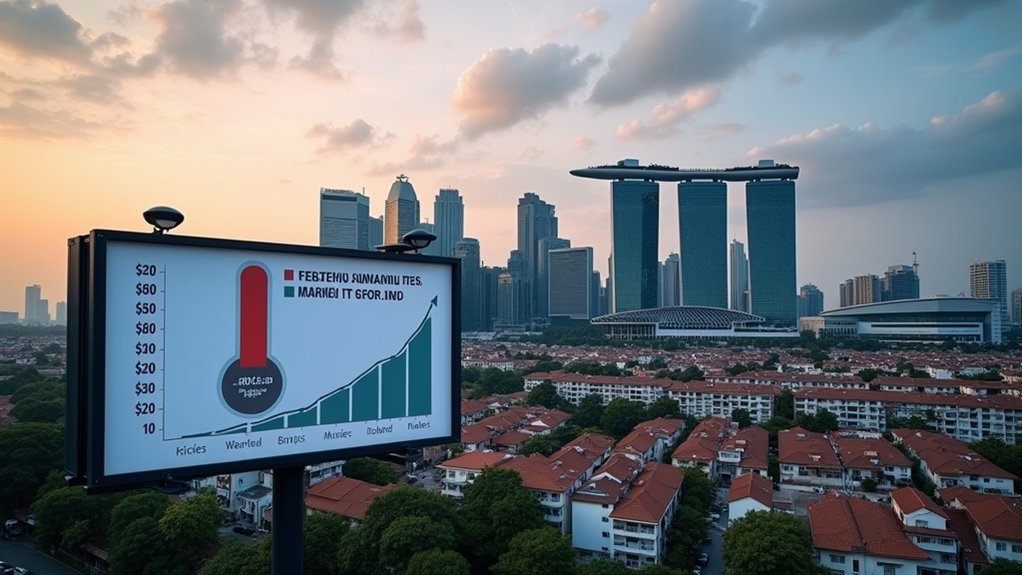

Singapore’s residential property market in 2025 is characterised by measured price appreciation, constrained new supply, and a stabilising rental landscape. This is set against a backdrop of steady macroeconomic growth and resilient household balance sheets. Rental prices are expected to rise by a modest 2–4%, supported by tight inventory and sustained expatriate demand, reinforcing the market’s investment appeal.]
Private home values are projected to rise by about 3–4% over the year, while the overall Property Price Index is forecast to increase by a more modest 1–2%, broadly in line with headline inflation and indicating a phase of consolidation rather than exuberant expansion.
Singapore’s housing market enters a consolidation phase, with prices tracking inflation rather than surging ahead
Data from Q1 2025 show the PPI advancing 0.81% quarter-on-quarter and 3.33% year-on-year, with the Housing Index reaching 210.70 points, up from 209.40 in Q4 2024.
These gains are largely attributed to new launches in fringe and suburban districts, where buyers are seeking a balance of price, connectivity, and living space. Projects such as Hougang Residences illustrate the persistent appeal of suburban-luxury positioning.
On the supply side, new private home completions are estimated to fall sharply, declining 41.3% to 5,348 units in 2025 from 9,103 units in 2024.
Suburban completions are projected at just 2,010 units. Although 16 new projects scheduled in H1 2025 will introduce about 8,025 units excluding executive condominiums, the overall pipeline remains constrained and unsold inventory is low.
This underpins price resilience even as policymakers monitor affordability.
Transaction dynamics reflect this mixed environment. Q1 2025 private residential sales reached 7,261 units, slipping 2.3% quarter-on-quarter but surging 71.7% year-on-year.
Benign interest rates and improved sentiment lifted activity from a low base. For 2025 as a whole, new private home sales are expected in the 8,000–9,000 range, compared with 6,500 units in 2024.
Some consultancies, such as CBRE, place forecasts slightly lower at 7,000–8,000 units, citing a shift in launch composition towards higher-priced Core Central Region and Rest of Central Region projects that could temper volumes.
The rental market is moving towards equilibrium. The island-wide private rental index registered a 2.4% year-on-year increase in Q3 2025, with landed rents up 1.6%.
Forecasts generally cluster around 1–4% growth for the year, supported by tight rental stock and limited completions but moderated by uncertainties in foreign hiring and evolving demand patterns.