
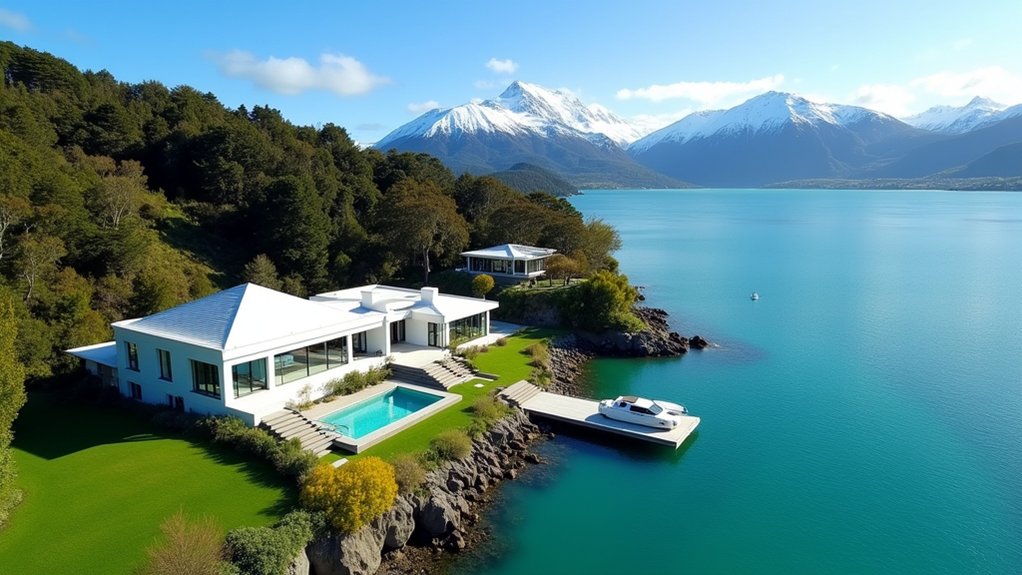

Less than eight years after New Zealand introduced its 2018 foreign buyer prohibition, Parliament has enacted a targeted exemption, amending the Overseas Investment Act 2005 under urgency on December 12, 2025, to permit specified investor-resident cohorts—Active Investor Plus (AIP), legacy Investor 1, and legacy Investor 2 visa holders, including certain permanent residents from prior investor categories—to acquire or build a single residential or lifestyle dwelling, typically in the premium Auckland and Queenstown segments, subject to Overseas Investment Office (OIO) consent and non-sensitive land parameters.
The change is expected to take effect in early 2026, with market guidance indicating implementation likely before April 1, 2026, and a review scheduled for 2027 to assess outcomes and compliance settings. Consent must be secured before entering an unconditional deal, as OIO approval is required prior to signing a binding contract, tender submission, or auction bidding for such land under the new pathway (OIO consent).
Eligibility is confined to resident-visa pathways that require substantial capital deployment, with AIP requiring NZ$5–15 million depending on profile, the legacy Investor 1 category requiring NZ$10 million, and the legacy Investor 2 category requiring NZ$3 million, while also capturing certain Permanent Resident Visa holders who obtained status through earlier investor streams.
The residential purchase itself does not count toward AIP investment thresholds, separating personal accommodation decisions from the policy’s capital-attraction objectives, and preserving the integrity of investment allocation rules.
Transaction parameters impose a high price floor and a tight volume cap, with a minimum property value of NZ$5 million including GST, either as an existing home acquisition or as combined land-and-build expenditure for a new dwelling.
Only one property may be held under this pathway, and any subsequent purchase requires disposal of the prior asset, a design intended to limit portfolio accumulation and speculative churn, while still enabling relocation or rebuilding decisions.
The exemption also removes any 183-day stay requirement tied to the designated property purchase for eligible investors.
The measure is expected to concentrate on Auckland and the Southern Lakes, and is framed as affecting only a few hundred transactions annually, given that roughly 90% of qualifying stock sits outside the mass-market. This selective, high-value approach contrasts with broader regional property trends, such as Singapore’s private residential market, where transaction volumes surged by 71.7% year-on-year in Q1 2025, reflecting the intense demand dynamics that wealthy investors increasingly seek to diversify away from.
Operationally, applicants must secure OIO consent, typically via a streamlined decision process within five working days, with fees of NZ$2,040 for existing homes and NZ$3,500 for new builds, and processing often occurring within two to three days.
A national interest test may apply but is generally unlikely for non-sensitive residential land, and post-transaction reporting is required, including build progress updates where relevant.
Use is permitted for personal, family, holiday, or rental purposes, while commercial development and rapid flipping are excluded, and any business activity remains subject to local planning controls.