
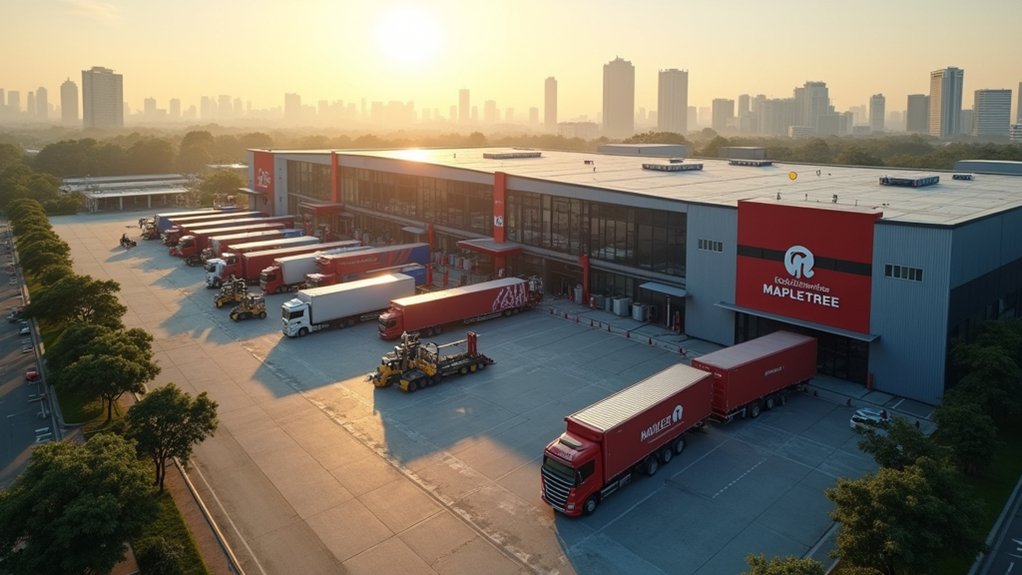

Although Mapletree Logistics Trust (MLT) continued to demonstrate operational resilience across its pan-Asian logistics portfolio, its latest results for the quarter ended 31 December 2025 reflected a clear compression in unitholder returns.
The distribution per unit (DPU) declined 9.3% year-on-year to 1.816 cents despite remaining broadly stable on a quarter-on-quarter basis at 1.816 cents, up marginally from 1.815 cents. On an adjusted basis, excluding divestment gains that had previously supplemented payouts, DPU similarly registered at 1.816 cents, representing a 2.1% year-on-year contraction, highlighting the impact of reduced non-recurring income on total distributions. Within the broader Singapore REIT universe, MLT’s performance mirrors sector-wide adjustments as peers also contend with currency headwinds and portfolio reshaping.
The available distributable amount to unitholders fell 8.5% to S$92.671 million, even as the total number of issued units increased 0.9% to 5,103 million, resulting in a dilution effect layered on top of weaker distributable income.
This deterioration in distributable income was underpinned by a 3.1% year-on-year reduction in gross revenue to S$176.8 million and a 3.3% decline in net property income (NPI) to S$152.0 million. NPI margins and gearing remained stable over the period, underscoring the REIT’s disciplined financial management and operational efficiency.
On a constant currency basis, gross revenue and NPI still slipped 1.2% and 1.5% respectively, underscoring that the pressures were not solely translational in nature.
Management attributed the softer top line primarily to foreign exchange headwinds from regional currency depreciation against the Singapore dollar, coupled with the loss of income from 12 divested properties over the period and the absence of divestment gains that had previously lifted DPU.
Quarter-on-quarter gross revenue also decreased, driven by the absence of contributions from four divested assets. Lower solar income and weaker contributions from certain regional markets, together with negative rental reversions in China averaging -2.2%, further weighed on performance.
Despite these headwinds, operational indicators remained broadly constructive, with portfolio occupancy improving 30 basis points quarter-on-quarter to 96.4%, supported by higher occupancy in Singapore, Japan, and South Korea. While Singapore’s broader property landscape continues to be shaped by public housing programs that accommodate approximately 80% of the population, commercial real estate sectors such as logistics and industrial assets operate under different market dynamics driven by e-commerce growth and supply chain optimization.
Property operating expenses declined 1.6% year-on-year to S$24.8 million, aided by currency depreciation and the elimination of costs tied to divested properties, while borrowing costs eased as lower base rates benefited unhedged SGD borrowings.
The quarter also reflected an ongoing portfolio reshaping, with the number of properties decreasing from 175 at the start of 3Q FY25/26 to 174 at quarter-end, compared with 180 properties at the beginning of the nine-month period and 187 in the prior year.
Contributions from Mapletree Joo Koon Logistics Hub and earlier acquisitions partially mitigated the earnings drag from disposals, aligning with the trust’s stated portfolio rejuvenation strategy targeting modern logistics facilities.
On a nine-month basis, DPU declined 10.7% to 5.443 cents, with adjusted DPU excluding divestment gains down 4.8%, reflecting the combined impact of weaker revenue, softer NPI, and a 9.8% drop in distributable income to unitholders.
During the same period, property operating expenses were reduced by 2.9% to S$73.0 million.
Within a market context of regional currency weakness and ongoing asset recycling, MLT’s geographically diversified platform continued to support a stable quarterly DPU profile, though at a lower absolute level year-on-year.
This stability was observed despite the lower absolute distribution levels, as the logistics sector maintained generally resilient, long-term demand fundamentals.