
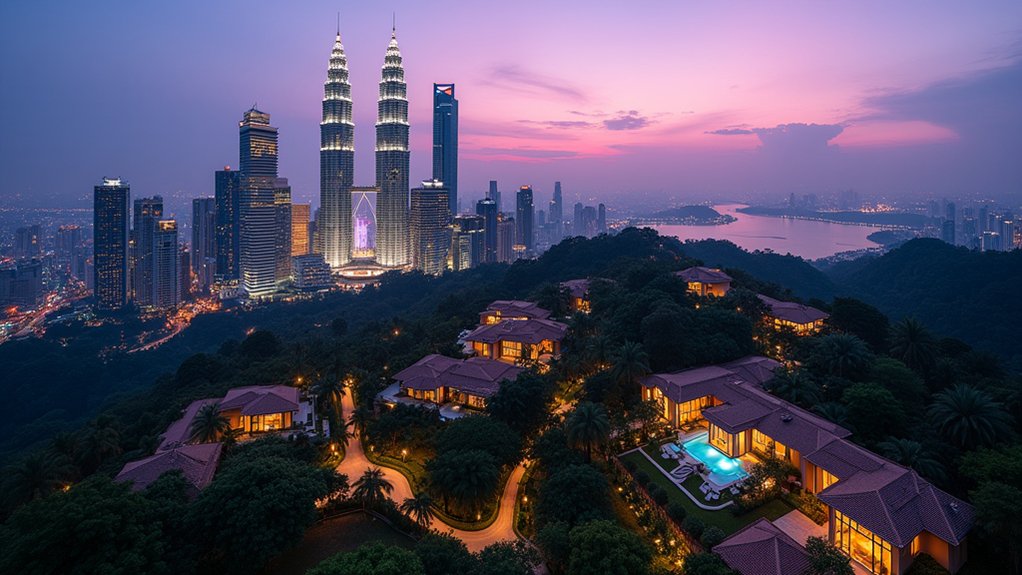

Anchoring the upper end of Kuala Lumpur’s 2025 residential market, million-ringgit transactions concentrated in prime enclaves where scarcity, address prestige, and high-rise product specifications translated into outsized ticket sizes, with a Four Seasons Place apartment changing hands at RM14.5 million and developments such as Aira Residence appearing among the city’s top recorded sales.
Million-ringgit KL deals clustered in scarce, prestige enclaves, led by a RM14.5m Four Seasons Place sale and Aira Residence.
Within the city’s luxury bracket, KL City, Bangsar, and Damansara Heights repeatedly surfaced as high-value nodes, while Mont Kiara differentiated itself by recording the highest volume of luxury-unit sales, reflecting depth of demand even where individual ticket sizes varied by project and unit configuration.
These headline deals occurred against a national backdrop in which total property transactions reached 416,413 units valued at RM241.87 billion, a 4.1% year-on-year value gain despite a 1% contraction in volume. The market was supported by Malaysia’s 5.2% GDP growth in 2025, helping sustain confidence even as transaction volumes softened.
Residential activity dominated market composition, representing 61.6% of transaction volume and 44.8% of total value, while the House Price Index rose 2.6% to 233.1 points and the average house price stood at RM502,922, indicating moderate price expansion amid mixed liquidity conditions.
In the residential segment specifically, 256,512 transactions were recorded at RM108.27 billion, with volume declining 1.5% and value edging up 1.3% from 2024, a pattern consistent with selective absorption and a tilt toward higher consideration values.
Properties priced above RM1 million comprised 5.9% of residential transactions, terraced houses accounted for 41.3% of deals, and high-rise units represented 14.3%, underscoring that luxury apartments, while influential in value terms, remained a small share of overall turnover.
Within Kuala Lumpur, secondary market activity outpaced primary transactions, and condominium and apartment sales reached RM1.6 billion in Q3 2025, reinforcing the role of resale liquidity in price discovery for premium stock. This dynamic mirrors broader regional trends, as real estate investment volumes across Asia-Pacific have risen sharply, with Singapore recording a 28% year-on-year increase to S$28.62 billion in 2024, reflecting sustained institutional confidence in the region’s property fundamentals.
By March 2026, 21,179 properties were listed above RM1 million, signalling a sizable competitive set around the million-ringgit threshold even as top-end sales continued to cluster in central and established addresses.
Supply conditions remained disciplined but uneven, with new residential launches falling 14.9% to 64,487 units and a sales performance rate of 35.5%, while unsold completed units increased to 30,471 valued at RM17.73 billion, led by condominiums and apartments at 47.1% of overhang.
Government support remained in focus, with a RM20 billion Housing Credit Guarantee Scheme allocation aimed at assisting about 80,000 homebuyers.
Pricing by type diverged, as terraced homes rose 3.3% and semi-detached homes 2.8%, whereas high-rise prices fell 2.6% year-on-year to RM375,421 in Q3.