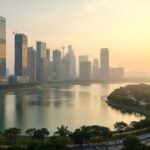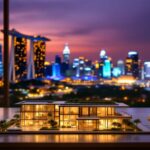
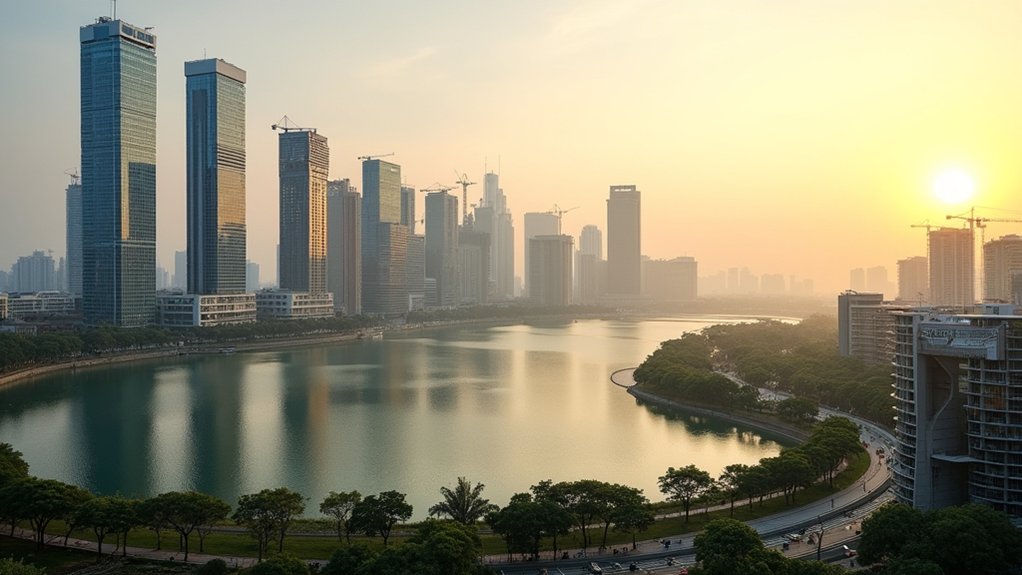

Increasingly, Jurong Lake District is being positioned as Singapore’s principal decentralised commercial node, with its evolution shaped by a blueprint first announced in 2008 and a revised master plan revealed in 2017 that responded to public feedback calling for a second business district outside the traditional city centre. That long planning arc has now moved into a more transactional phase, marked by the first mixed-use land parcel launch in June 2023 and the recalibration of a larger 6.5ha master developer site that was tendered in 2023 but not awarded in 2024 after bids fell below the reserve price.
Jurong Lake District’s shift from long-range vision to market execution underscores Singapore’s push for a second major business district.
The subsequent decision to split that original tract into smaller parcels reflects both market pragmatism and risk management, with the 3.7ha Town Hall Link white site released on March 16, 2026 under the first-half 2026 Government Land Sales reserve list. Its potential yield totals 186,139 sq m gross floor area, including a minimum 40,000 sq m of office space, about 1,200 private homes, and 44,000 sq m allocated to retail, serviced apartments, hotel, sports, recreation, community uses, medical clinics, and attractions. Because reserve-list sites require a minimum acceptable price or sufficient market interest to be triggered, actual launch timing remains demand-dependent. Analysts estimate the land cost could still exceed S$1.8 billion, making developer partnerships a likely feature of any eventual bid.
Infrastructure preparation has become a central part of the state’s de-risking approach. Government works include demolishing state property and constructing an underground pedestrian link to the future Cross Island Line station, complementing the Jurong Region Line, the revitalised 90ha Jurong Lake Gardens, a district cooling plant, and a pneumatic waste conveyance system central station. These district-level systems are meant to let future projects plug into shared utilities more readily while improving overall energy efficiency. These investments are intended to lower upfront complexity for developers while reinforcing the district’s sustainability narrative.
Jurong Lake District is not starting from zero. Around the Jurong East MRT interchange, there is already approximately 185,000 sq m of office space, about 2,000 homes, and supporting retail, healthcare, and institutional uses, while Jurong Gateway Hub and the upcoming Science Centre add further activity generators. Singapore’s broader push for urban rejuvenation also extends to aging private and public developments in surrounding areas, where policy reforms to the Land Titles (Strata) Act are under active review to potentially reduce collective sale consent thresholds and unlock redevelopment activity.
Analysts generally view the residential and retail components positively, citing pent-up housing demand, constrained new CBD supply, and improved accessibility, although the office requirement may temper bidding interest amid higher construction costs, inflation, oil prices, and interest rates. Long-term, the district remains aligned with Singapore’s decentralisation strategy and regional hub aspirations.