
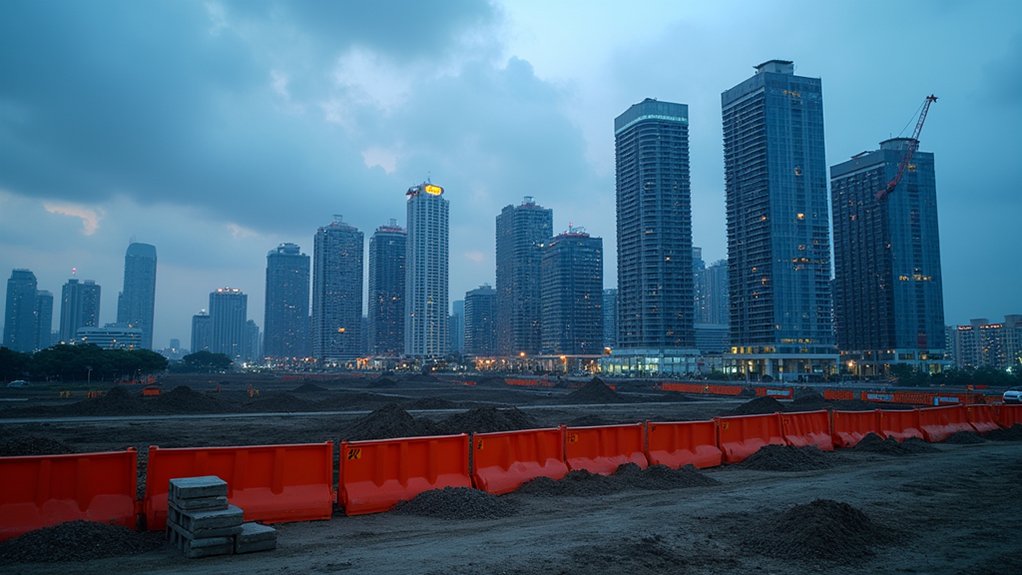

When four or five developers still queue up for the same suburban plot, you’d think land was running short — yet the numbers coming out of the 2026 Government Land Sale tenders tell me something else is going on. Top bids at New Upper Changi hit about S$1,537 psf ppr. Kallang Close came in near S$1,415 psf ppr. Winning bids have been beating analyst estimates by 10 to 15 per cent, and gross development costs on the bigger parcels now brush past S$1 billion. And supply is hardly scarce — confirmed-list GLS sites for the first half of 2026 alone can yield about 4,575 private homes, including roughly 635 executive condominium units.
Four or five bidders per plot doesn’t mean land is scarce — it means certainty now carries a premium.
Here’s the part that matters to those of us watching prices in our own neighbourhoods. At Kallang Close, the maths only works at roughly S$3,000 psf average to reach a 10 per cent net margin. That’s not a stretch target anymore — it’s the entry ticket.
Now the contrarian bit. I don’t think developers are being reckless with land. GLS gives them timing certainty and none of the collective-sale headaches, so they’re paying a premium for a predictable pipeline, not out of exuberance. The UOL–CapitaLand Development consortium’s S$1.4 billion bid for New Upper Changi landed 13.8 per cent above the next-highest offer from City Developments and Hong Realty, which tells you how thin the pack really was. The sharper risk sits elsewhere: concentration. Four Bedok-area sites alone could deliver about 3,185 units. The New Upper Changi parcel could yield roughly 1,010. When several launches in one town chase the same pool of HDB upgraders within months of each other, absorption stretches — and stretched absorption, not land price, is what kills margins. We saw echoes of this in earlier suburban clusters where later launches quietly trimmed pricing to move stock. The Bayshore Road tender, which drew eight bids and closed in March 2025, set a new benchmark for suburban land values in the Outside Central Region at S$1,388 psf ppr, signalling just how early this competitive intensity took hold.
So what does this mean if you’re buying? If you’re an upgrader eyeing one of these projects, you’re likely paying close to S$2,700–S$3,000 psf, and you shouldn’t expect much cushion on day one. Your protection comes from picking the site with the best walk to the MRT, the schools your kids can actually get into, and a unit mix that isn’t wall-to-wall shoebox. Buy in a launch phase where the developer still has stock to sell and you’ll have more room to negotiate than you think.
Watch financing spreads and construction tenders over the next two quarters. If either moves against developers, the bidding discipline we haven’t seen yet will arrive on its own.