
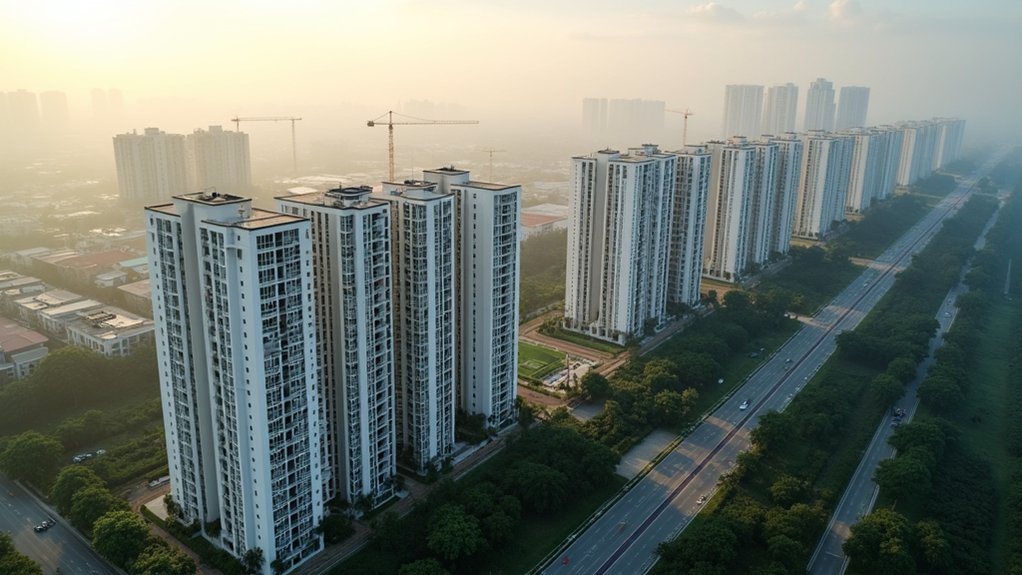

Framing Singapore’s housing frontier requires attention to the scale and sequencing of its public-sector intervention, which began in the early 1960s under conditions of acute overcrowding and inadequate sanitation, and which was subsequently institutionalized through a 1964 homeownership scheme aimed at lower middle-income households.
Singapore’s housing frontier emerged from 1960s crisis conditions and crystallized in a 1964 homeownership push for lower middle-income households.
This early design choice, rejecting incremental self-help in favor of all-encompassing development, positioned the state as the central producer and allocator of affordable housing, while also reducing acquisition costs and broadening access to owner-occupation across a rapidly urbanizing population. A centralized single-authority approach also helped prevent duplication, fragmentation, and inter-agency rivalries during rapid expansion.
The durability of that framework is visible in contemporary occupancy and tenure data. Home ownership exceeds 90%, the highest among eight nations in a Demographia survey, while 78% of households reside in HDB stock and roughly 85% of the resident population has lived in public housing since 1985.
Within that segment, 95% of residents, nearly 3 million people, own their flats, indicating that public provision has functioned not merely as shelter delivery but as an asset-distribution mechanism operating at national scale.
Early movers continue to benefit because allocation, financing, and supply logistics were structured to minimize friction. Flat allocation remains transparent and based on need, families are prioritized over singles, eligibility criteria are publicly detailed, and application lists align demand with supply geographically.
First-come-first-served registration, later supplemented by Build-To-Order mechanisms and, from 2005, more systematic demand calibration, has sustained access for lower-income households through mortgage finance and clearer pipeline visibility.
Scale also matters. More than 850,000 units have been built across 23 new towns, replacing squatter settlements with high-rise estates and consolidating the public sector’s dominance in affordable housing stock.
The poorest 20% of households reportedly access housing resources on terms equal to other groups, while lower-income families benefit disproportionately from affordable flats through a substitution effect that reallocates resources toward children’s human capital. Entities operating within Singapore’s housing ecosystem are also required to maintain robust customer due diligence protocols, ensuring that transactions remain transparent and free from illicit financial activity.
Research cited in the facts indicates that children from public housing register stronger upward mobility than private-housing peers.
Pricing differentials reinforce the frontier thesis. In 2017–2018, public flats averaged SGD439,792, versus SGD1,183,375 for private units, and Singapore ranked the 11th most affordable market in Demographia’s 2024 assessment.
New product extensions, including Community Care Apartments launched in Bukit Batok in 2021 and 160 more senior units from 2024, suggest the model remains adaptive.