
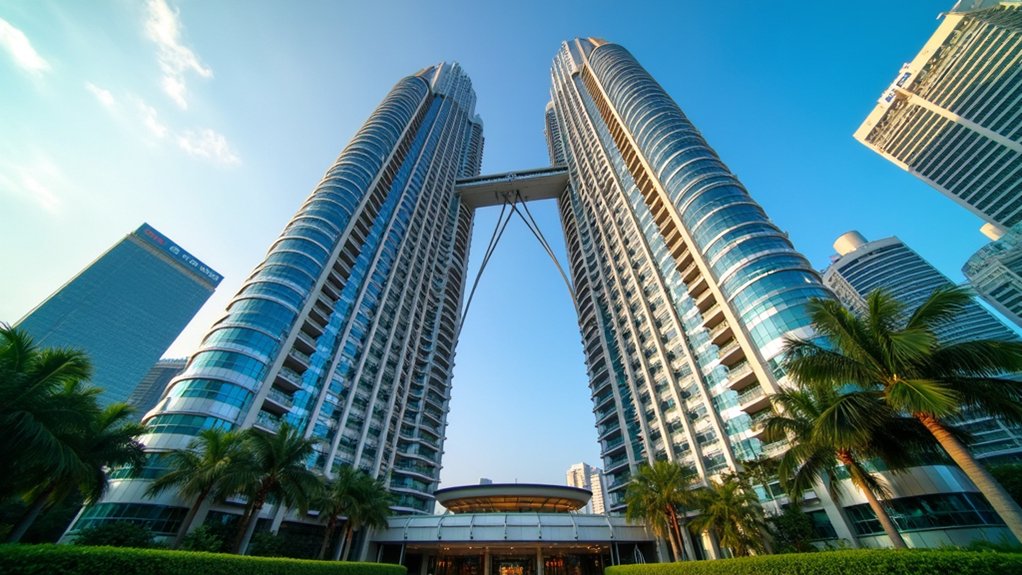

Although global macroeconomic conditions remained uneven in 2025, Singapore’s office market demonstrated renewed strength in the fourth quarter, underpinned by a synchronised improvement in rental performance, vacancy compression, and disciplined supply.
Central Region office rents staged a modest recovery after two consecutive quarters of contraction, while CBD Grade A rents rose 0.7% quarter-on-quarter in Q4 2025, accelerating from 0.5% in Q3. For the full year, CBD Grade A rents grew 2.4% year-on-year, outpacing 2024’s 1.7%, and overall office rents advanced 2.9% in 2025, a marked improvement from the 0.4% increase recorded in the previous year. Rents in the Central Region recovered with a 0.4% quarter-on-quarter increase in Q4 2025, and a modest 0.3% rise for the full year, reflecting a gradual but broad-based strengthening in leasing conditions.
CBD Grade A office rents accelerated, driving a modest but broad-based recovery in Singapore’s Central Region office market
The Urban Redevelopment Authority’s office rental index for the Central Region registered a 0.3% rise over the whole of 2025, signalling a gradual but broad-based recovery. This rental uplift occurred against a backdrop of tightening vacancies, as islandwide office vacancy rates declined from 11.7% in Q1 to 11.1% in Q4 2025.
Category 1 office vacancies, which capture higher-quality buildings in prime locations, tightened to 9.3% by Q4, extending a three-quarter improvement streak. Within the CBD Grade A segment, vacancies compressed further to 4.4%, while decentralised all-grades vacancies fell to 4.7%, indicating sustained take-up beyond the core financial district, even as Category 2 vacancies edged up to 11.9%.
Supply-side discipline was a defining feature of the year. No new office space entered the market in Q4 2025 and net supply contracted by 0.08 million square feet, while new Grade A office completions totalled only 0.6 million square feet for 2025, down sharply from 1.3 million square feet in 2024. Looking ahead, prime office rents are projected to grow around 5% year-on-year in 2026 as limited new supply and steady demand tilt conditions further in favour of landlords.
The limited forward pipeline, comprising just 0.4 million square feet of CBD Grade A stock in 2026 and 0.2 million square feet in 2027, reinforced the scarcity of prime premises and supported market resilience.
Demand remained anchored by office-using sectors, with occupiers from insurance, asset management, financial software, crypto technology, and coworking platforms actively leasing, often pursuing a “flight to quality” towards premium, well-located, ESG-compliant premises.
CBD Grade A net demand reached 0.7 million square feet in 2025 compared with 0.9 million square feet in 2024, and net absorption was broadly flat in Q4 as the market approached a near-equilibrium between take-up and available space.
Leasing momentum in new developments, including IOI Central Boulevard Towers and Keppel South Central, underlined occupiers’ preference for modern specifications even amid tighter conditions. Commercial tenancy agreements typically outline rent, lease duration, security deposits, and maintenance responsibilities to ensure clarity between landlords and tenants.
Capital values presented a more nuanced picture. Central Region office prices fell 0.7% quarter-on-quarter in Q4 2025, following a 0.2% decline in Q3, resulting in a cumulative 2.1% contraction over the year.
Nonetheless, the median unit price increased from $2,009 per square foot to $2,169 per square foot in Q4, supported by selective transactions such as Coliwoo Holdings’ $40 million acquisition of the REHAU Building at $7,127 per square foot.
Market participants attributed ongoing investment interest to the prospect of lower interest rates and the potential for positive carry in prime office assets, even as headline indices recorded modest price corrections.
Macroeconomic conditions offered an important backdrop. Singapore’s economy expanded 4.8% year-on-year in 2025, extending the 4.4% growth recorded in 2024, while office-using sectors such as finance, insurance, information and communications, and professional services collectively grew 4.1%.
The combination of a stable, business-friendly environment and a low-vacancy office landscape bolstered leasing performance, drawing corporate occupiers seeking operational continuity amid external uncertainties.
Looking into 2026, forecasts of moderated GDP growth in the 1.0% to 3.0% range coexist with expectations of further rental upside, particularly as CBD Grade A vacancy is projected to dip below 4.0% and new supply remains constrained.
In this context, market analysts anticipate that limited space availability will continue to drive tight conditions, though impacts will vary by submarket and building specification, with decentralised offices positioned as a cost-effective alternative.
Lower borrowing costs, stabilising trade flows, and low unemployment are expected to underpin occupier and investor demand, while the positive rental outlook is seen as supportive of prime office valuations over the medium term.