
Singapore’s town transformation narrative is crystallising most visibly in Marina Bay, where the precinct, first conceptualised in 2005 as a strategic extension of the Central Business District, has evolved into a 24/7 “work–live–play” hub anchored by multinational occupiers in banking, wealth management, technology, and commodities.
Singapore’s Marina Bay is evolving into a vibrant 24/7 work–live–play hub extending the CBD
This evolution has been guided by successive land use decisions, beginning with the first residential development secured via a Government Land Sales (GLS) site in 2002 by City Developments Ltd and AIG, and is now framed by the Master Plan 2025, gazetted on 1 December 2025, which sets out a 10‑ to 15‑year development horizon.
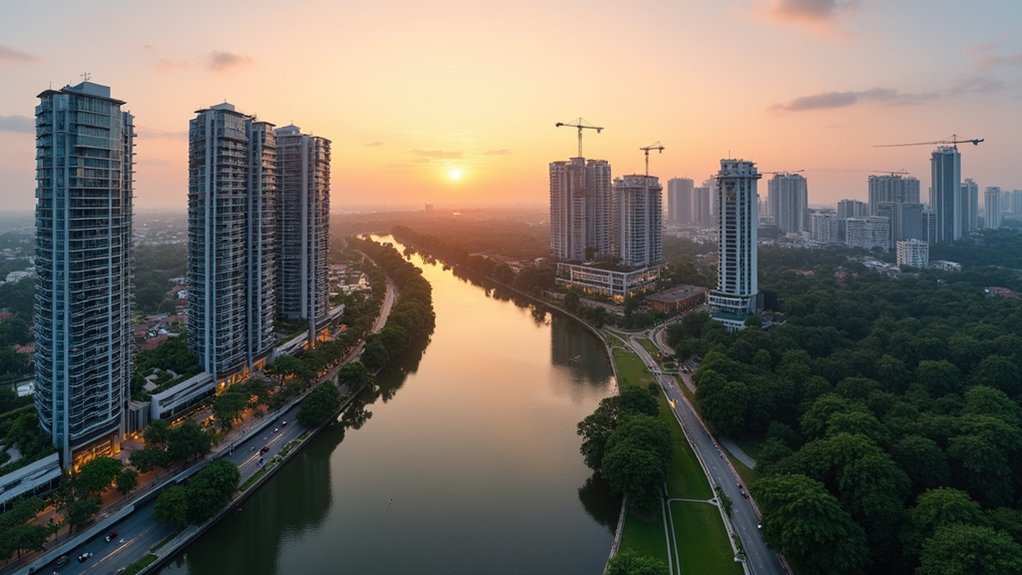
Residential intensification has become a central lever of this urban repositioning, with approximately 1,900 new units being injected through projects such as One Marina Gardens and W Residences Marina View. Reflecting this, Singapore’s broader urban population growth is projected at about 1.9945% in 2024, underscoring the demographic momentum underpinning demand for homes in emerging mixed‑use districts. Additional homes and amenities in Marina South will further support this momentum, as the precinct is planned to accommodate around 10,000 residences within a 45‑hectare mixed‑use neighborhood.
Alongside these, the scheduled January 2026 launch of Newport Residences reconstitutes the former Fuji Xerox Towers into a mixed-use asset.
Sites at Marina Gardens Crescent and Marina Gardens Lane, placed on the GLS Reserve List, signal a future pipeline that will further shift the district from an office‑dominant core into a more balanced, mixed‑use urban environment.
This shift is supported by the extension of the CBD Incentive (CBDI) and Strategic Development Incentive (SDI) schemes for another five years from February 2025.
The CBDI scheme, targeting rejuvenation along Anson Road, Cecil Street, Robinson Road, and Shenton Way, underpins large‑scale redevelopment such as The Skywaters and Newport Plaza in the Anson–Tanjong Pagar corridor.
Meanwhile, the SDI scheme enables adjacent‑site aggregation and redevelopment in Orchard Road, Marina Centre, and the CBD fringe, including a hyper‑mixed Marina Square redevelopment by Singapore Land. Evolving buyer preferences now reflect increasing demand for smart homes and eco‑friendly developments, supported by properties with BCA Green Mark certification commanding 3‑5% higher premiums.
These instruments, first launched in 2019 and refreshed in 2025, are calibrated to promote higher‑value land uses, adaptive reuse, and mixed‑use conversions.
Immediately south, Marina South is being planned as a 45‑hectare mixed‑use precinct with around 10,000 homes, complemented by parks, public spaces, retail, hotel, and office components.
This development is reinforced by civic and recreational anchors such as NS Square, targeted for completion in 2027, and Passion Wave Outpost @ Bayfront, due in 2026.
Across these districts, Singapore’s integrated planning approach, underpinned by ten core principles, aligns high‑density development with sustainability objectives under the Green Plan 2030.
This plan seeks 80% green‑certified building stock by floor area, tighter energy efficiency standards, and ESG‑driven investments.