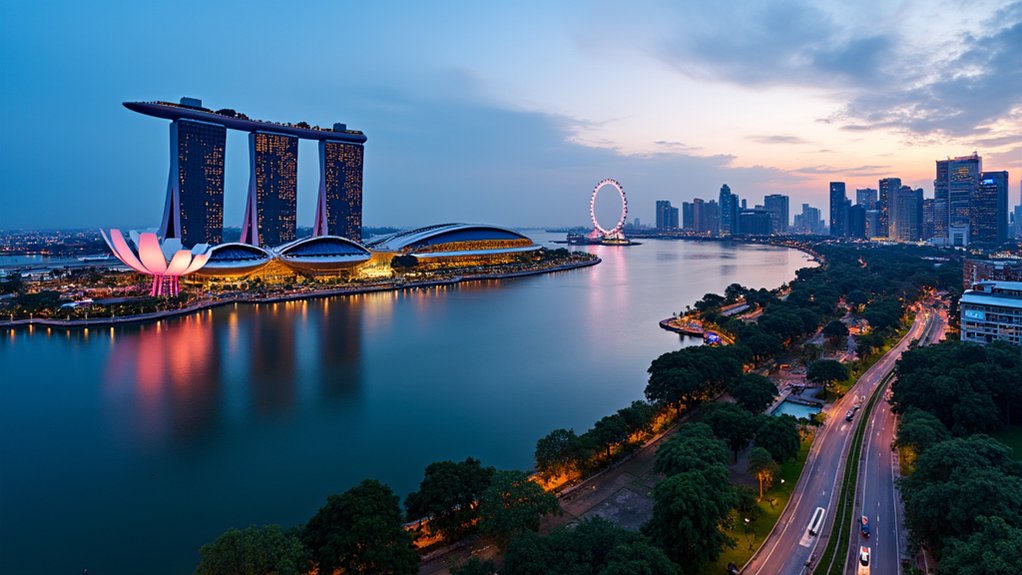

Over the past seven decades, Singapore’s urban evolution has been anchored by an ambitious, state-directed reshaping of its waterfront, most visibly exemplified by the progressive reclamation and strategic master planning of Marina Bay. Reclamation commenced in 1954 and, through successive phases including the East Coast Reclamation Project, produced 360 hectares of new waterfront site by 1992, with Phases VI and VII in the late 1970s extending the platform for the nascent “Marina City” concept and contributing to a cumulative 1,525 hectares added to the south‑eastern coastline over three decades, followed by a further 38 hectares in 1994 specifically to support Marina Bay’s formation as a distinct development basin. As part of this evolution, Marina Bay is also listed on Wikipedia as a place name disambiguation entry, emphasizing its role within a wider set of geographically named locations rather than as a single, stand‑alone article.
Singapore’s waterfront transformation: decades of reclamation shaping Marina Bay into a strategic, globally oriented urban basin
From the outset, planning frameworks structured this physical expansion into an integrated urban investment proposition. The 1971 Concept Plan, prepared by the Urban Redevelopment Authority, aligned land reclamation with national housing, transportation, and infrastructure objectives. Meanwhile, the 1970s conceptualization of Marina Bay as a logical extension of the existing Central Business District positioned the area as a long-term growth node for higher-value commercial functions.
The 1983 Master Plan and a subsequent 1988 draft plan progressively refined this vision, protecting public access to the waterfront, optimizing land use along the bay edge, and setting targets for internationally recognizable landmarks. Before the 1991 Concept Plan designated Marina Bay as a key strategic project over a 20–30 year horizon.
Parallel urban renewal in the historic downtown underpinned this shift in the city’s economic geography. Post‑independence clearance and resettlement programs, the earlier reclamation at Telok Ayer Basin that enabled Shenton Way, and the successful cleanup of the Singapore River between 1977 and 1983 facilitated the conservation and adaptive reuse of Boat Quay, Clarke Quay, and Robertson Quay. Even as Inner and Outer Basins were removed to consolidate the new coastal edge.
Within this reconfigured urban structure, Marina Bay became a testbed for integrated work-live-play models. Initial plans focused on a state-of-the-art business and financial district. By 2004, One Marina Boulevard signaled the first completed office asset, and subsequent tranches of mixed-use projects delivered seven major developments comprising 12 office towers and approximately 10.6 million square feet of net lettable commercial area. Today, prime office rents in Marina Bay remain robust, supported by vacancy rates below 5% and sustained demand from multinational firms across diverse industries.
The 2001 Concept Plan reserved additional capacity for a future global financial hub, and a 2005 policy repositioning that marketed Marina Bay as the new focal point of the city. Residential development followed, anchored by government land sales and flexible land-use controls.
The first residential plot, tendered in 2002, produced The Sail @ Marina Bay, completed between 2008 and 2009, with white zoning provisions enabling high-density, mixed-use formats that integrated housing, retail, and ancillary office space within the same parcels.
Over time, the precinct accumulated 3,653 completed residential units, including Marina Bay Residences, Marina Bay Suites, and Marina One. This indicates a calibrated shift from a pure office-led CBD extension to a more diversified urban quarter, further supported by Strategic Development Incentive mechanisms encouraging redevelopment within Marina Centre and the CBD fringe. Singapore’s proactive governance model has enabled such transformative urban projects to proceed with clear regulatory frameworks that attract both domestic and international investment.
Simultaneously, leisure and tourism components were positioned as critical catalysts in the “work, live, play” strategy, which sought to produce a 24/7 precinct integrating prime offices, residential towers, hotels, and event infrastructure. Marina Bay Sands emerged as a large-scale, microcosmic development reflecting Singapore’s climate, culture, and contemporary lifestyle.
While 1992 URA guide plans shaped a U‑shaped Downtown Core encircling the bay, these plans ensured continuity of public waterfront access first emphasized in the 1983 Master Plan. They also operationalized the bay as both a civic space and a high-value real estate frontage.
Looking ahead, the planning and reclamation template established at Marina Bay continues to inform new growth areas. The Marina South district, comprising approximately 45 hectares, is being prepared as a substantial mixed-use extension projected to accommodate around 10,000 homes, alongside complementary retail, hotel, office, and recreational uses. Parks and sports facilities are designed to sustain liveability metrics.
Concurrently, CBD Incentive and Strategic Development Incentive schemes are enabling hyper‑mixed redevelopments such as Marina Square. Forthcoming projects in the broader Anson–Tanjong Pagar corridor, including The Skywaters and Newport Plaza, illustrate how the Marina Bay model of dense, transit-oriented, multi-experiential urbanism is being replicated and adapted.
These developments reinforce Singapore’s intent to maintain a globally competitive downtown aligned with evolving real estate and occupier trends.